4 Types of Plastic Molding Processes: Advantages, Limitations & How to Choose
Choosing the Right Plastic Molding Process Matters
Selecting the right plastic molding process has a major impact on:
- Manufacturing cost
- Tooling investment
- Product quality
- Production speed
- Material selection
- Surface finish
- Long-term scalability
Many product development problems are caused by selecting the wrong manufacturing process too early.
At CNMOULDING, we help customers evaluate molding methods based on:
- Part geometry
- Production volume
- Cosmetic requirements
- Mechanical performance
- Tooling budget
- Lead time
- Assembly requirements
Different plastic molding technologies are suitable for very different production scenarios. The best process is not always the most advanced one — it is the one that fits the product and production strategy best.
1. Injection Molding
Best For
- High-volume production
- Precision plastic parts
- Complex geometries
- Tight tolerances
- Engineering plastics
- Automotive & medical components
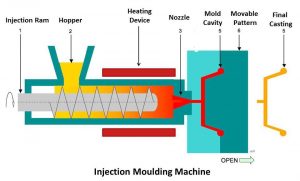
Injection molding is the most widely used plastic manufacturing process for precision industrial production.
Molten plastic is injected into a steel mold cavity under pressure, allowing highly repeatable manufacturing with excellent dimensional consistency.
Advantages of Injection Molding
Excellent Dimensional Accuracy
Injection molding is ideal for parts requiring:
- Tight tolerances
- Stable repeatability
- Multi-cavity consistency
- Precision assembly fit
It is commonly used for:
- Automotive connectors
- Medical device housings
- Electronic enclosures
- Industrial precision components
Precision molding capability can reach:
±0.01 mm\pm 0.01\ \mathrm{mm}
depending on material, tooling design, and process control.
High Production Efficiency
Once tooling is completed, injection molding supports:
- Automated production
- Fast cycle times
- Stable mass production
- Low per-part cost
Multi-cavity molds significantly improve output efficiency in high-volume manufacturing.
Wide Material Compatibility
Injection molding supports a broad range of engineering plastics including:
- ABS
- PP
- PC
- PA66 GF
- PBT
- PPS
- TPU
- PEEK
This makes it suitable for both cosmetic and structural applications.
Limitations of Injection Molding
High Initial Tooling Cost
Injection molds require precision steel tooling and complex machining.
Tooling costs can range from:
1000 USD∼100000+ USD1000\text{ USD} \sim 100000+\text{ USD}
depending on complexity, cavitation, and industry requirements.
Longer Tool Development Time
Complex molds involving:
- Sliders
- Lifters
- Hot runner systems
- Multi-cavity structures
require significant engineering and validation time.
When Injection Molding Is the Right Choice
Injection molding is usually recommended when:
- Production volume is high
- Dimensional consistency is critical
- Cosmetic quality matters
- Engineering plastics are required
- Automated production is needed
- Long-term unit cost reduction is important
2. Blow Molding
Best For
- Hollow plastic products
- Lightweight containers
- Bottles and tanks
- Large-volume packaging
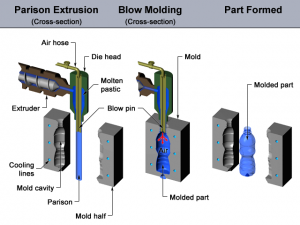
Blow molding is primarily used for manufacturing hollow plastic parts by inflating heated plastic material inside a mold cavity.
Advantages of Blow Molding
Very Efficient for Hollow Parts
Blow molding is highly optimized for products such as:
- Bottles
- Fluid containers
- Fuel tanks
- Plastic drums
- Packaging containers
The process enables lightweight hollow structures with relatively low material consumption.
Lower Part Weight
Compared with solid molded components, blow molded products achieve:
- Reduced material usage
- Lower transportation cost
- Better weight efficiency
This is important in packaging and automotive applications.
Fast Production Speed
Blow molding supports very high production rates for standardized packaging products.
Limitations of Blow Molding
Limited Structural Precision
Blow molding is not suitable for:
- Tight-tolerance components
- Precision assemblies
- Complex engineering parts
Wall thickness control is less precise compared with injection molding.
Restricted Part Geometry
Blow molding mainly supports hollow shapes.
Complex internal structures and precision features are difficult to achieve.
When Blow Molding Is the Right Choice
Blow molding is recommended when:
- The product is hollow
- Lightweight structure is important
- Packaging production volume is high
- Precision tolerance is not critical
- Large container manufacturing is required
Thermoforming
3. Thermoforming
Best For
- Large thin-wall parts
- Medium-volume production
- Low tooling budgets
- Fast product launch
- Large cosmetic panels
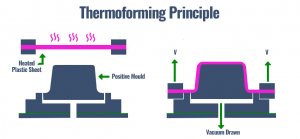
Thermoforming heats plastic sheet material and forms it over a mold surface using vacuum or pressure.
Advantages of Thermoforming
Much Lower Tooling Cost
Compared with injection molding, thermoforming tooling is significantly less expensive.
This makes thermoforming ideal for:
- Prototype development
- Medium production runs
- Large plastic components
- Budget-sensitive projects
Tooling lead time is also much shorter.
Excellent for Large Plastic Parts
Thermoforming is commonly used for:
- Equipment housings
- Automotive panels
- Medical trays
- Industrial covers
- Protective enclosures
Large parts are often more economical to produce using thermoforming rather than injection molding.
Faster Product Development
Because tooling complexity is lower, thermoforming supports faster:
- Prototype iteration
- Product validation
- Market launch
Limitations of Thermoforming
Lower Dimensional Precision
Thermoformed parts generally have lower dimensional consistency compared with injection molded parts.
Secondary CNC trimming is often required.
Limited Complex Geometry
Thermoforming is less suitable for:
- Deep ribs
- Complex undercuts
- Tight tolerance assemblies
- Multi-functional precision parts
Surface Detail Limitation
Fine texture and intricate cosmetic details are more difficult to achieve than with injection molding.
When Thermoforming Is the Right Choice
Thermoforming is recommended when:
- Parts are large and thin-wall
- Tooling budget is limited
- Production volume is medium
- Speed to market is important
- Precision tolerance is not extremely critical
For many large plastic parts, thermoforming provides a better cost-to-volume balance than injection molding.
Compression molding
4. Compression Molding
Best For
- Thermoset materials
- Composite components
- High-strength structural parts
- Fiber-reinforced applications
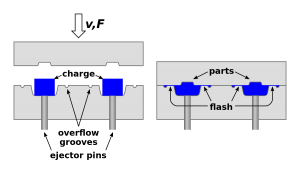
Compression molding uses heated molds and pressure to form thermoset or composite materials into finished shapes.
Advantages of Compression Molding
Suitable for High-Strength Composite Parts
Compression molding is widely used for:
- SMC components
- Carbon fiber parts
- Structural panels
- Electrical insulation components
It supports excellent mechanical strength and rigidity.
Lower Material Stress
Compared with injection molding, compression molding often produces:
- Lower internal stress
- Better structural stability
- Reduced fiber damage
This is important for composite applications.
Good for Large Structural Components
Compression molding is commonly used for:
- Automotive structural parts
- Industrial panels
- Electrical housings
- Heavy-duty composite products
Limitations of Compression Molding
Slower Production Cycle
Compression molding generally has longer cycle times compared with injection molding.
Lower Production Efficiency
It is less suitable for ultra-high-volume consumer product manufacturing.
Limited Surface Precision
Secondary machining or finishing may be required for precision surfaces and cosmetic applications.
When Compression Molding Is the Right Choice
Compression molding is recommended when:
- Structural strength is critical
- Composite materials are required
- Thermoset plastics are used
- Fiber reinforcement is needed
- Production volume is medium
Comparison of the 4 Plastic Molding Processes
| Process | Main Advantages | Main Limitations | Best Production Volume | Typical Applications |
|---|---|---|---|---|
| Injection Molding | Precision, automation, complex geometry | High tooling cost | Medium to High Volume | Automotive, medical, electronics |
| Blow Molding | Efficient hollow part production | Limited precision | High Volume | Bottles, tanks, packaging |
| Thermoforming | Low tooling cost, large parts | Lower dimensional accuracy | Low to Medium Volume | Trays, panels, enclosures |
| Compression Molding | High structural strength | Slower production | Medium Volume | Composite & thermoset parts |
How to Choose the Right Plastic Molding Process
The correct process depends on balancing:
- Production volume
- Tooling investment
- Product complexity
- Mechanical performance
- Cosmetic requirements
- Lead time
- Long-term manufacturing cost
For example:
Choose Injection Molding If:
- You need precision parts
- Production volume is high
- Assembly consistency is important
- Engineering plastics are required
Choose Thermoforming If:
- Parts are large
- Tooling budget is limited
- Product launch speed matters
- Production volume is moderate
Choose Blow Molding If:
- The product is hollow
- Lightweight packaging is required
- Production speed is critical
Choose Compression Molding If:
- Composite materials are needed
- Structural strength matters
- Thermoset materials are required
Engineering Support for Process Selection
At CNMOULDING, we help customers evaluate the most suitable manufacturing process based on real engineering and production requirements — not just tooling capability.
Our engineering support includes:
- DFM analysis
- Manufacturing feasibility review
- Tooling cost evaluation
- Mold flow analysis
- Material selection
- Production strategy optimization
We support both prototype development and stable mass production for automotive, medical, electronics, industrial, and consumer product applications.
FAQ
Which plastic molding process is best for high-volume production?
Injection molding is usually the best choice for high-volume precision plastic part manufacturing.
Which process has the lowest tooling cost?
Thermoforming generally has much lower tooling cost than injection molding.
What process is best for hollow plastic products?
Blow molding is specifically designed for hollow products such as bottles and containers.
Which molding process is best for large plastic parts?
Thermoforming is often more cost-effective for large thin-wall plastic components.
What process is used for composite materials?
Compression molding is commonly used for thermoset and fiber-reinforced composite parts.
Start Your Plastic Manufacturing Project
Looking for the right plastic molding solution for your product?
CNMOULDING provides:
- Injection molding
- Thermoforming
- Vacuum forming
- Precision mold manufacturing
- DFM engineering support
- Prototype & mass production solutions
Our engineering team helps customers select the most cost-effective and production-stable manufacturing process based on real project requirements.
Contact us today for technical evaluation and quotation support.
- 24-Hour Engineering Response
- Precision Manufacturing Capability
- Competitive Tooling Cost
- Stable Production Quality
- Worldwide Export Support
Email: webmaster@cnmoulding.com
Phone: +86-21-52913487
