2026年10月8日星期四

Injection Mold Manufacturing Process Explained


Injection mold manufacturing is a critical step in plastic part production. The quality of the mold directly determines part accuracy, surface finish, and long-term production stability.

A well-designed and precisely manufactured mold ensures consistent output, reduces defects, and improves overall production efficiency.
China mold

Mold Design

Mold design is the foundation of the entire manufacturing process. Before any machining begins, engineers must evaluate part geometry, material behavior, and production requirements.

Key considerations in mold design:

  • Part structure and wall thickness
  • Shrinkage rate of the selected material
  • Gate type and location
  • Cooling system layout
  • Ejection mechanism

A proper design helps prevent common issues such as warpage, sink marks, and short shots before production even starts.

In most projects, DFM (Design for Manufacturability) analysis is conducted to optimize the design and reduce risk.

CNC Machining

After the mold design is finalized, CNC machining is used to manufacture the main mold components with high precision.

What CNC machining does:

  • Cuts mold cavities and cores
  • Creates precise geometries based on CAD data
  • Ensures dimensional accuracy

Advantages:

  • High precision (tight tolerances)
  • Repeatability
  • Suitable for complex mold structures

CNC machining is the primary process for shaping mold steel and defining the final geometry of the mold.

EDM (Electrical Discharge Machining)

EDM is used to create detailed features that cannot be achieved through standard CNC machining.

When EDM is used:

  • Sharp internal corners
  • Deep ribs or narrow slots
  • Complex cavity details

How it works:

EDM uses electrical sparks to erode material from the mold surface, allowing extremely precise and intricate shapes.

Advantages:

  • High precision for complex geometries
  • Ability to machine hardened steel
  • Excellent for fine details

EDM is essential for high-precision molds, especially in automotive and electronic components.
Mold Assembly and Finishing

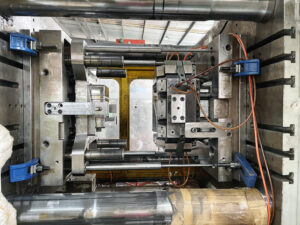
After machining, all mold components are assembled and tested.

This stage includes:

  • Fitting and alignment of mold components
  • Polishing and surface finishing
  • Installation of cooling channels and ejector systems

Surface finishing plays a key role in the final appearance of plastic parts.

Mold Testing (T1 Sampling)

Before mass production, the mold undergoes trial runs (T1 samples).

Purpose of T1 testing:

  • Verify part dimensions
  • Identify defects (warpage, sink marks, etc.)
  • Adjust process parameters

Multiple iterations may be required to achieve optimal results.

Why Mold Quality Matters

A high-quality mold provides:

  • Stable and repeatable production
  • Reduced defect rates
  • Longer mold lifespan
  • Lower overall production cost

Poor mold quality can lead to ongoing production issues and increased maintenance costs.

Choosing the Right Mold Manufacturer

When selecting a mold supplier, consider:

  • Engineering experience
  • Precision machining capability
  • Quality control system
  • Lead time reliability
  • Experience with your industry (automotive, electronics, etc.)

A reliable supplier will support both mold development and long-term production.

FAQ – Injection Mold Manufacturing

What is the most important step in mold manufacturing?

Mold design is the most critical step, as it determines part quality and manufacturability.

What is the difference between CNC and EDM?

CNC is used for general machining and shaping, while EDM is used for fine details and complex geometries.

How long does it take to make an injection mold?

Typically 15–25 days for standard molds, depending on complexity.

Why is mold testing necessary?

Testing ensures the mold produces parts that meet design and quality requirements before mass production.

If you are looking for a reliable partner for mold development and production, explore our
👉 injection mold manufacturing services

We provide full support from design to mass production with consistent quality and fast lead times.

General Engineering Plastics for vacuum thermoforming


Plastics for vacuum thermoforming

Vacuum thermoforming China factory based in shanghai.

CNMOULDING is an expert in Custom Plastic Thermoforming in china. We are specialists in creating molded plastic components using thermoforming (vacuum thermoforming china) techniques. For  20 years we have created innovative thermoforming solutions in multiple industries and assisted companies in materials selection. Regulatory requirements, attaining cost targets, and more. To better fulfill customer requirements. CNMOULDING expanded to include INJECTION MOLDING capabilities to its list of thermoplastics manufacturing operations.

So now, from small parts to large parts, from short runs to long runs, simple to multiple part designs. whatever the plastics part you need. Whether by vacuum thermoforming china processes or injection molding in china process. We will suggest the best process for your project.

General Purpose Engineering Plastics of vacuum thermoforming China

General Engineering Plastics for vacuum thermoforming: ABS – Engineering Grade

ABS has perhaps the best balance of properties when the cost is a factor. It has good chemical and
stress resistance as well as a combination of toughness with rigidity and creeps resistance. Easily machined,
tough, low cost rigid thermoplastic material. ABS exhibits high impact strength & is ideal for turning, drilling,
and milling. Good chemical and stress-cracking resistance to inorganic salt solutions, alkalis, acids, and some
oils. Excellent abrasion resistance; electrical properties, moisture and creep resistance.


Acetal Copolymer & Delrin ® Acetal Homopolymer


Acetal provides high strength and stiffness coupled with enhanced dimensional stability and ease of machining. As a semi-crystalline material, acetal is also characterized by a low coefficient of friction and good wear properties. Especially in wet environments. Because of its high strength, modulus, and resistance to impact and fatigue. Acetal is used as a weight-saving metal replacement. Copolymer acetal is preferred to Delrin where centerline porosity is concerned.

General Engineering Plastics for vacuum thermoforming: Nylon ® – Extruded & Cast

The exceptional bearing and wear properties of Nylon® make it one of the most widely used plastics in the world. Nylon® is frequently used as a replacement for bronze, brass, aluminum, steel, and other metals. As well as other plastics, wood, and rubber. • High tensile strength and modulus of elasticity Nylon exhibit high impact resistance. A high heat distortion temperature. It resists wear, abrasion, and vibration. Nylon can withstand contact with chemicals, alkalies, dilute acids, or oxidizing agents.

• Available Types: 6/6 (extruded), 6 (cast) – Premium Brands: Nylatron & MC 901
• Available in Natural, Black, MD, Glass-Filled, Oil-Filled & various other compounds.

High-Pressure Aluminum Die Casting & Precision Tooling Solutions


Die casting is a highly efficient manufacturing process utilized to produce structurally complex, high-precision metal components. Unlike traditional gravity or sand casting, High-Pressure Die Casting (HPDC) forces molten metal—predominantly aluminum and aluminum alloys—into a precision-engineered steel mold cavity under extreme hydraulic pressure.

Similar in kinematics to plastic injection molding, advanced die casting integrates sophisticated core-pulling mechanics, automated dosing, and high-performance thermal management/cooling systems to handle the extreme thermal loads of molten non-ferrous metals.

Core Engineering Advantages of Aluminum Die Casting

For global OEMs and tier-1 buyers, our precision aluminum die casting and advanced tooling services deliver superior mechanical integrity and manufacturing economics:

1. Superior Dimensional Accuracy & Surface Integrity

  • Near-Net Shape Manufacturing: HPDC achieves exceptionally tight dimensional tolerances and excellent surface finishes straight out of the tool.
  • Minimized Secondary Machining: Due to the precision of the mold cavity, parts require minimal to no post-cast machining (such as milling or turning), significantly reducing raw material waste, tooling wear, and labor costs.
  • High Strength-to-Weight Ratio: The rapid solidification of the molten aluminum against the water-cooled steel tool forms a dense, fine-grained skin layer, yielding components with high tensile strength, hardness, and excellent dimensional stability under load.

2. Advanced Automation & High-Volume Efficiency

  • Rapid Cycle Times: Our fully automated hot and cold chamber die casting cells ensure high throughput. Depending on component size and cavitation, a single cell can yield thousands of shots per shift.
  • Extended Tool Life & Insert Strategy: Utilizing premium, hot-work tool steels (such as premium H13 or Dievar) combined with advanced proprietary heat treatment and surface coatings, our die casting tools achieve an operational life spanning hundreds of thousands to over a million cycles.

3. Optimized Economic Value & Hybrid Integration

  • Maximum Material Utilization: High fluidity and plasticity of aluminum allows for ultra-thin walls and intricate internal geometries, reducing overall part weight (lightweighting) without sacrificing structural rigidity.
  • Insert & Multi-Component Integration: We specialize in over-molding or inserting alternative metal components (such as steel bushings or threaded studs) directly into the die cast tool during the cycle, eliminating downstream assembly labor and lowering the total bill of materials (BOM).

Industrial Applications & Core Product Portfolio

Thanks to aluminum’s excellent thermal conductivity, low specific gravity, and high machinability, our die-cast components and custom tooling are widely embedded across critical manufacturing sectors:

1. Automotive & Powertrain Engineering

  • Engine & Transmission Components: Structural engine cylinder blocks, complex cylinder heads, valve covers, rocker arms, valve seats, and transmission housings.
  • Chassis & Drivetrain: Lightweight aluminum wheels, suspension brackets, steering gear housings, and structural cross-members engineered to support vehicle lightweighting initiatives.

2. E-Mobility & Electrical Infrastructure

  • Powertrain Enclosures: Heavy-duty electric motor housings, stator frames, end shields, and inverter enclosures requiring precise thermal dissipation and strict ingress protection (IP sealing).
  • Power Construction: High-strength electrical connectors, brackets, cable clamps, and power grid structural accessories.

3. Fluid Power & Precision Machinery

  • Pump & Valve Hardware: High-pressure hydraulic pump housings, pneumatic valve bodies, impeller assemblies, and fuel system components designed to withstand internal pressure and prevent porosity leaks.
  • Precision Instruments: Dimensionally stable chassis, frames, and internal brackets for optoelectronic devices and measuring equipment.

4. Architectural Hardware & Industrial Louvers

  • Structural & Decorative Accessories: High-durability structural construction connectors, architectural bracket systems, heavy-duty industrial fencing components, and premium decorative hardware featuring advanced powder-coated or anodized surface finishes.

Our Engineering Edge in Die Cast Tooling Design

The success of a high-pressure die casting run depends entirely on the engineering of the tool. Molten aluminum is highly corrosive to steel at elevated temperatures and prone to shrinkage porosity or gas entrapment if the gate and venting system are poorly engineered.

  • Advanced Flow & Thermal Simulation: We run comprehensive gating and thermal analysis to optimize material flow, eliminate air traps, and position cooling lines to mitigate shrinkage defects.
  • Porosity Control: Through precise vacuum-assisted die casting and optimized intensification pressure mapping, we ensure the internal density of the casting meets strict structural and leak-testing requirements.

From initial product review to million-cycle production tooling, we engineered every step to ensure your components launch on time, on budget, and on print.