ABS Parts Cracking Around Copper Inserts: Causes and Solutions
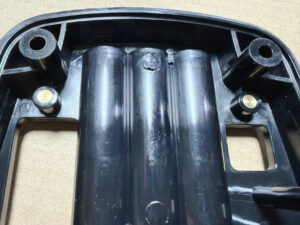
Solving Cracking Issues in ABS Parts with Copper Inserts
Copper inserts are widely used in ABS injection molded parts to improve thread strength and assembly durability. However, cracking around inserts is a common problem in many molded components.
These cracks may appear immediately after molding, during insert installation, or after long-term use. In most cases, the issue is related to stress concentration, improper insert design, or incorrect molding parameters.
Why ABS Parts Crack Around Copper Inserts
1. Excessive Stress Around the Insert
Copper and ABS have very different thermal expansion rates. During cooling, the material shrinks while the metal insert remains stable, creating internal stress around the insert area.
If the wall thickness is too thin or the interference fit is too tight, the ABS part may crack easily.
2. Insert Temperature Is Too Low
When cold copper inserts are installed into ABS parts, the sudden temperature difference can increase local stress and reduce bonding quality.
Preheating inserts before installation can help reduce cracking risks.
3. Improper Hole or Boss Design
Poor boss design is one of the most common causes of cracking.
Typical design problems include:
- Boss walls that are too thin
- Sharp corners at the base
- Insufficient draft angle
- Small radii around the insert area
These features create stress concentration during molding and assembly.
4. Overheating During Ultrasonic or Heat Insertion
Excessive heat during insert installation can degrade the ABS material and create microcracks around the insert.
This problem is especially common in ultrasonic insertion processes with incorrect pressure or welding time settings.
5. Residual Stress from Injection Molding
Incorrect molding parameters can leave high residual stress inside ABS parts.
Common causes include:
- Injection pressure too high
- Mold temperature too low
- Uneven cooling
- Fast cooling cycles
Residual stress may not be visible immediately but can lead to cracking after assembly or during product use.
How to Prevent Cracking in ABS Parts with Copper Inserts
Optimize Boss Design
A proper insert boss design greatly improves part strength.
Recommended practices:
- Use larger radii at the boss base
- Maintain uniform wall thickness
- Avoid sharp internal corners
- Leave enough material around the insert
Good structural design reduces stress concentration and improves durability.
Preheat Copper Inserts
Preheating inserts before installation helps reduce thermal shock and improves material flow around the insert.
This is particularly important for larger inserts or thick-wall ABS parts.
Adjust Injection Molding Parameters
Optimizing molding conditions can significantly reduce internal stress.
Recommended adjustments include:
- Increase mold temperature appropriately
- Reduce excessive injection pressure
- Improve cooling balance
- Avoid overly fast cycle times
Proper process control improves dimensional stability and crack resistance.
Control Insert Installation Parameters
For ultrasonic or heat staking processes:
- Avoid excessive insertion force
- Reduce overheating
- Optimize welding time and pressure
- Use proper insertion alignment
Controlled installation prevents local material damage.
Choose the Right ABS Grade
Some ABS materials offer better impact resistance and stress crack resistance than standard grades.
For demanding applications, consider:
- High-impact ABS
- Heat-resistant ABS
- PC/ABS blends
Material selection can greatly improve long-term performance.
Conclusion
Cracking around copper inserts in ABS parts is usually caused by stress concentration, poor boss design, incorrect molding conditions, or improper insert installation.
By optimizing part design, controlling molding parameters, and improving insert installation processes, manufacturers can significantly reduce cracking problems and improve product reliability.

没有评论:
发表评论